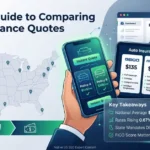
When evaluating Texas auto insurance quotes, securing adequate financial protection matters just as much as finding a competitive premium. In my advisory work with Texas policyholders, I consistently see drivers fixate solely on baseline prices.
As a result, they inadvertently take on severe personal liability. Simply put, understanding localized rate dynamics and statutory requirements is essential for protecting your assets on Texas roads.
Texas Auto Insurance: 2026 Rate & Policy Snapshot
| Coverage Level | Average Annual Rate | Average Monthly Rate | Primary Asset Protection |
|---|---|---|---|
| State Minimum Liability (30/60/25) | $550 – $680 | $46 – $57 | Satisfies the basic legal mandate only. Offers zero physical damage protection for your vehicle. |
| Standard Coverage (50/100/50 + PIP) | $1,150 – $1,420 | $96 – $118 | Moderate bodily injury and property liability, paired with vital medical expense buffers. |
| Full Coverage (100/300/100 + Comprehensive & Collision) | $1,990 – $2,498 | $166 – $208 | Comprehensive protection |
2026 Costs & Rates: What to Expect in Texas
Auto premiums across the Lone Star State are largely driven by heavy traffic, severe weather events (including hail and hurricane claims), and county-level risk assessments. On average, Texas drivers with clean driving records pay approximately $182 per month for full coverage policies.
Location matters just as much as driving habits. Rates fluctuate significantly depending on whether you reside in dense metropolitan hubs like Harris County (Houston) and Dallas County, or quieter, lower-risk rural counties. Drivers who maintain a clean record and a FICO-based insurance score above 750 consistently secure the most aggressive premium discounts.
👉 Source: Texas Department of Insurance (TDI) Auto Guide
Finding the Cheapest Auto Insurance for Young Drivers in TX
Finding the cheapest auto insurance for young drivers is an uphill battle. Statistical risk profiles and a lack of prior driving history push rates up quickly. In Texas, a 20-year-old driver typically pays upwards of $390 per month for an individual full coverage policy.
To cut down these staggering premiums, young motorists should maximize carrier discounts. Start with the Good Student Discount (which requires maintaining a 3.0+ GPA or B average) and enrollment in telematics-based safe driver programs. Additionally, adding a young driver to an existing parent or multi-vehicle policy rather than purchasing a standalone policy can reduce overall annual premiums by as much as 40%.
👉 Source: Texas Department of Public Safety – Financial Responsibility & SR-22
The 30/60/25 Rule: Texas Minimum Liability Explained
Under Chapter 601 of the Texas Transportation Code, every motorist operating a motor vehicle must maintain basic financial responsibility. This state statutory requirement is formally designated as the 30/60/25 liability limit:
- $30,000 Bodily Injury Liability (BIL): The maximum compensation paid toward medical expenses per person injured in an at-fault accident.
- $60,000 Bodily Injury Liability (Total): The maximum total payout for all injured parties per accident event.
- $25,000 Property Damage Liability (PD): The absolute cap paid to repair or replace third-party vehicles, structures, or personal property.
Under Texas law, insurers must also offer you Personal Injury Protection (PIP) and Uninsured/Underinsured Motorist (UM/UIM) coverage. If you choose not to carry these coverages, you are required to reject them in writing.
👉 Source: Consumer Reports – Auto Insurance Buying Guide
Carrier Comparison: Pros & Cons of Top TX Providers
Selecting the right carrier takes more than just finding the lowest price. You must balance baseline premium pricing against claim settlement responsiveness. Regional customer satisfaction across Texas matters, too.
Top Texas Auto Insurance Providers (2026 Comparison)
| Carrier | Best For | Average Full Coverage (TX) | Key Advantages (Pros) | Potential Drawbacks (Cons) |
| State Farm | Overall Value & In-Person Agents | ~$1,680 / yr (~$140/mo) | Features an extensive Texas agent network and competitive bundle discounts. | Telematics app discounts require strict driving monitoring. |
| GEICO | Budget Direct-to-Consumer & Young Drivers | ~$1,790 / yr (~$149/mo) | Offers a robust digital management platform and the lowest initial entry rates. | Limited dedicated local agency assistance during complex claims. |
| Progressive | High-Risk Drivers & Prior Incidents | ~$2,150 / yr (~$179/mo) | Features the excellent Name Your Price® tool and accessible SR-22 insurance quotes in TX. | Standard full coverage rates trend higher for clean records. |
| USAA | Active Military, Veterans & Families | ~$1,410 / yr (~$118/mo) | Industry-leading claim payout satisfaction and the lowest average rates. | Strict military membership eligibility requirements. |
👉 Source: Texas Department of Insurance – Minimum Liability Requirements
How to Run a Car Insurance Comparison Quote Online
To secure optimal underwriting terms, gathering a car insurance comparison quote from at least three distinct carriers is standard financial practice. When shopping for updated 🔗 [Insert Internal Link to: texas auto insurance quotes], follow this sequential process. It guarantees an accurate, apples-to-apples evaluation:
- Audit Your Current Declarations Page: Identify your existing coverage limits, collision/comprehensive deductibles, and endorsement add-ons (such as roadside assistance or rental reimbursement).
- Collect Vehicle & Driver Data: Have your Vehicle Identification Number (VIN), annual estimated mileage, driver’s license numbers, and past five-year moving violation records ready.
- Lock In Matching Coverage Limits: When quoting across multiple carriers, ensure you request identical liability ceilings (e.g., 100/300/100) and deductible thresholds ($500 vs. $1,000). This guarantees baseline pricing parity.
- Audit Applied Discounts: Verify the quote includes your multi-policy bundling, anti-theft device installations, paperless billing, and defensive driving course completions.
👉 Source: Texas Department of Insurance – Tips for Shopping Auto Insurance
High-Risk Drivers & SR-22 Filings in Texas
Drivers with recent DUI/DWI convictions, multiple at-fault collisions, or citations for driving without active coverage get flagged quickly. Underwriting algorithms classify them as high-risk motorists. As a result, the Texas Department of Public Safety (DPS) often mandates the submission of an SR-22 Certificate of Financial Responsibility.
Here’s what you need to know: an SR-22 is not a standalone insurance policy. Instead, it is an official administrative filing submitted by your insurer directly to the Texas DPS. This document verifies your continuous liability coverage. If your policy lapses for any reason, the insurer is legally obligated to notify the state immediately. That notification triggers an automated suspension of your driving privileges and vehicle registration.
👉 Source: Consumer Reports – Auto Insurance Buying Guide
Expert Verdict: Is State Minimum Coverage Worth the Risk?
As an industry professional, my final verdict is clear. Carrying only the state minimum 30/60/25 liability limit is a massive financial gamble, and it rarely pays off.
The minor monthly savings are quickly eclipsed by the catastrophic risk of personal litigation if you cause a multi-vehicle collision or total a modern, expensive vehicle. When you are ready to protect your assets, do not just look for the absolute lowest premium number.
Instead, I strongly recommend generating comprehensive texas auto insurance quotes that include at least 100/300/100 liability limits. You should also add Uninsured/Underinsured Motorist (UM/UIM) protection.
Frequently Asked Questions (Texas Auto Insurance)
What is the state minimum car insurance in Texas?
Texas legally requires liability limits of $30,000 for bodily injury per person, $60,000 per accident, and $25,000 for property damage. The state legally enforces this mandate, and it is widely known as the 30/60/25 rule.
Who has the cheapest car insurance in Texas?
Based on 2026 data, State Farm and GEICO consistently offer the most affordable baseline rates for standard civilian drivers. However, USAA is almost always the cheapest overall option. You just have to meet their strict military eligibility requirements to qualify.
Is state minimum insurance the same as full coverage in TX?
No. State minimum insurance only covers the property damage and bodily injuries you cause to other people in an at-fault accident. In contrast, full coverage includes comprehensive and collision policies. These specific coverages actually step in to pay to repair or replace your own vehicle.
How much is car insurance for a 20-year-old in Texas?
On average, a 20-year-old driver in Texas can expect to pay around $390 per month for an individual full coverage policy. You can significantly reduce this heavy financial burden by remaining on a parent’s policy. Alternatively, leveraging good student and telematics discounts can help bring that rate down.
Can an insurance company cancel your policy without notice in Texas?
No. Texas law dictates that an insurance provider cannot cancel an active policy after 60 days unless there is a valid reason. Acceptable reasons include fraud, a license suspension, or non-payment. By law, they must provide you with a 10-day written notice before any cancellation takes effect.