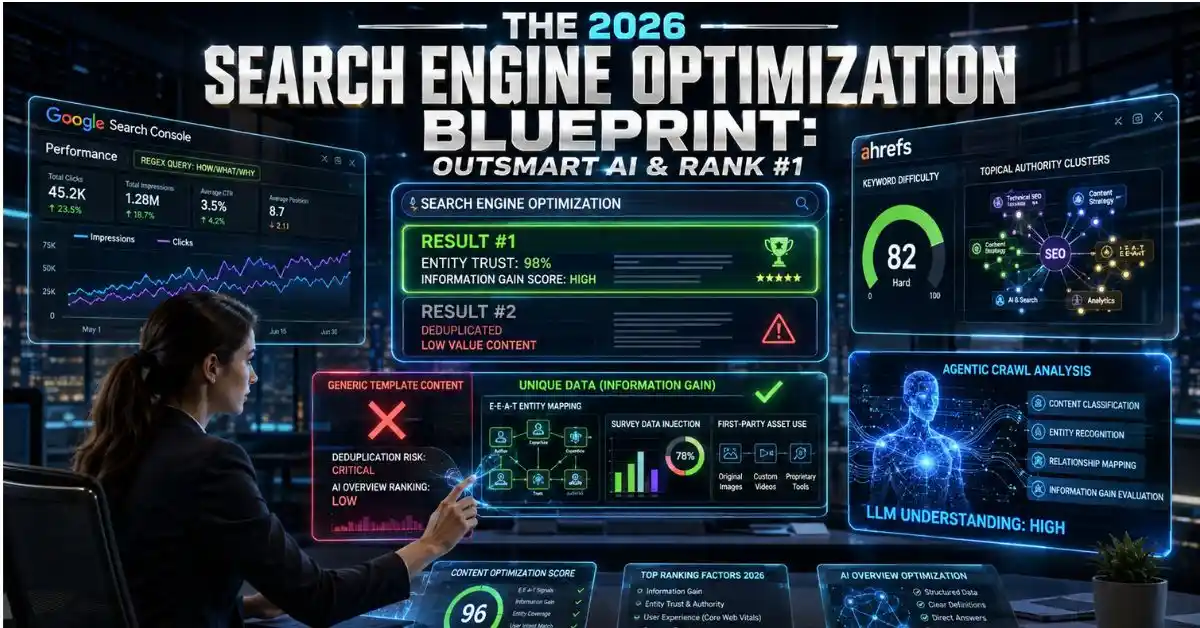
Struggling to survive the latest Google Core Updates, sudden de-indexing, and the absolute dominance of AI Overviews? You aren’t alone. Simply put, traditional search engine optimization is dead. It has been replaced by a ruthless algorithmic shift that aggressively filters out generic “me-too” content. If your organic traffic has flatlined or tanked entirely, there is a clear reason. Google’s machine-learning systems are likely classifying your pages as low-value commodity content.
This guide isn’t filled with vague theory. Instead, we are going to show you the exact, step-by-step workflows and tool settings you need right now. Let’s break down the “Information Gain” tactics required to outsmart generative AI filters, dominate Zero-Click searches, and rank #1 this year.
💡 Quick Takeaways
Survive AI Overviews (SGE): To bypass Google’s “Low Value Content” penalty, you must optimize for Information Gain. You do this by injecting first-party data and expert logic that LLMs simply cannot synthesize.
Execute Over Theory: We won’t just tell you to “do keyword research.” Instead, we will show you the exact buttons to click inside the industry’s top tools to extract low-hanging, high-converting traffic.
Future-Proof E-E-A-T: Building algorithmic trust is no longer optional. The bottom line is that you must structure your site as a machine-readable entity to dominate 2026 search ecosystems.
Set Up the Only Search Engine Optimization Tools You Actually Need
Forget those massive 50-tool lists. Algorithmic evaluation is highly streamlined in 2026, and your tech stack needs to reflect that reality. Want to cut through the noise and feed Google’s bots exactly what they crave? You really only need two core search engine optimization tools: Google Search Console (GSC) and Ahrefs.
Google Search Console (GSC) Setup for AI Optimization
GSC acts as your direct pipeline to Google. Simply put, it is the only platform that shows exactly how the search engine interacts with your site. Let’s break this down into a precise workflow. Here is how you find low-effort, high-reward keywords that Google already associates with your entity:
- Open Google Search Console 👉 [ search.google.com ] and select your domain property.
- Navigate to the left sidebar and click on Performance, then select Search results.
- Click on the + New filter button, select Query, and choose Custom (regex).
- Type ^(how|what|why|guide|best) to filter for high-intent informational queries.
- Sort the results by Impressions (High to Low), and look for queries where your average Position is between 11 and 25.
🎯 Why this works (Expert Logic):
When you identify queries ranking on page 2 or 3, you are exposing “Entity Proximity Gaps.” Google’s AI already trusts your site enough to place it near the top for these specific terms. Slightly updating these pages with better on-page signals takes full advantage of this trust. You require almost zero new crawl budget to push them straight to page 1.
Ahrefs Setup for Competitor Gap Analysis
Ahrefs is perfect for uncovering exactly what your competitors are doing right now. More importantly, it reveals exactly what they are missing.
- Log into Ahrefs 👉 [ahrefs.com] and go to Site Explorer.
- Enter your top competitor’s domain and hit enter.
- On the left sidebar, click Organic keywords.
- Set the Volume filter to a minimum of 100, and the KD (Keyword Difficulty) filter to a maximum of 20.
- Click Apply. You now have a list of easy-to-rank keywords your competitor is getting traffic for.
Execute Search Engine Optimization with “Information Gain”
“Information Gain” is a patented Google concept measuring how much new information a specific page adds to a topic. What happens if your article just rewrites the top 3 ranking pages? The AI considers your Information Gain score to be zero, and you face the dreaded “Low Value Content” penalty.
Here is the exact step-by-step workflow to safely inject first-party data into your content:
- Conduct a micro-survey: Use Google Forms to poll 50 people in your industry about a specific pain point.
- Export the data: Download the results as a CSV.
- Visualize the finding: Create a simple pie chart or bar graph in Canva.
- Embed the unique asset: Place this graphic at the top of your blog post with a custom caption like: “Based on our 2026 survey of 50 B2B marketers…”
🎯 Why this works (Expert Logic):
Generative AI engines and LLMs only train on historical data. They simply cannot generate new proprietary statistics. When Google’s crawlers discover a unique data point and an original image on your site, the algorithm must recognize your page as a primary source. This instantly elevates your E-E-A-T and bypasses strict deduplication filters.
DIY vs. Scaling with Search Engine Optimization Services
Time becomes a massive bottleneck once you master these daily workflows. Many growing businesses eventually transition from a DIY approach to hiring professional search engine optimization services.
Solo bloggers should generally stick to the DIY route and completely master Information Gain. However, managing a B2B SaaS or an e-commerce brand changes the math. Attempting to manually run GSC audits, build backlinks, and optimize complex entity schemas will actively stall your growth. You must delegate ground-level execution to scale, freeing you to focus on high-level strategy.
How to Vet a Search Engine Optimization Company (Anti-Scam Checklist)
Unfortunately, the SEO industry is still filled with bad actors and snake oil. Decide to hire a search engine optimization company? Use this exact checklist during your initial sales call to quickly filter out scammers:
- Ask to see their GSC, not Analytics: Scammers easily manipulate Google Analytics. Ask to see a live screen-share of a client’s Google Search Console showing a 12-month upward trend in non-branded Clicks.
- Ask about Information Gain: If their content strategy is just “we use Surfer SEO to hit keyword density,” run. They will get your site penalized.
- Demand an execution roadmap: A real agency will provide a granular, month-by-month sprint plan (e.g., Month 1: Technical Schema Audit, Month 2: Topical Cluster Expansion).
Case Study: What is Search Optimization in the Era of AI Overviews?
Let’s break this down with a real-world scenario from early 2026. A mid-sized B2B SaaS brand came to us facing a massive problem. Their organic traffic had plummeted by 65% following a recent core update. During our initial audit, their marketing director asked a very poignant question. “Exactly what is search optimization supposed to look like when AI just answers the user’s question directly in the search results?”
The Common Mistake:
They were publishing 15 SEO blog posts a month. However, every single article was just a generic regurgitation of the top 3 ranking competitors. They featured zero original data, no unique graphics, and a terrible site structure. As a result, Google’s algorithm flagged their entire blog directory as “low-value commodity content.” It simply offered zero Information Gain.
The Execution & Fix:
- We immediately halted their content production machine.
- We deployed the GSC Regex strategy (from Step 1) to find 15 existing pages sitting on Page 2 that already had high impressions.
- We interviewed their internal sales team to extract proprietary customer data. Then, we created 3 unique infographics for each of those 15 pages.
- Finally, we fixed their crawl budget issues and optimized their site structure for better entity recognition (if you struggle with indexing, I highly recommend checking out our comprehensive.
The Results:
The bottom line is the turnaround was rapid. Within 45 days, 11 out of the 15 updated pages shot directly to the top 3 positions. By adding first-party data, they completely bypassed the AI Overviews. Google’s algorithm actually needed to cite their original infographics as the primary source.
🎯 Why this works (Expert Logic):
You must stop treating SEO as a simple “word count and keyword density” game. Start treating it as an “exclusive data” game instead. Doing this forces the algorithm’s hand. AI engines are explicitly programmed to reward the primary source of new data. By injecting proprietary insights, you transform a generic page into a highly authoritative entity asset. This makes it nearly impossible to penalize or algorithmically replace.
5 Technical FAQs for 2026 SEO
- Why is my page “Discovered – currently not indexed” in GSC? This usually points to a crawl budget and quality issue. Google’s bot found your URL. However, it decided the page wasn’t worth the server resources to crawl right away.
- The Fix: Go to GSC > Pages, and click on the affected URLs. First, improve the page’s “Information Gain.” Next, add 2-3 internal links from high-authority pages on your site, and finally hit Request Indexing.
- How do I optimize specifically for Google’s AI Overviews (SGE)? AI Overviews constantly pull from highly structured, direct answers. You need to be incredibly precise here.
- The Fix: Structure your H2s as the exact questions your users are asking. Follow this immediately with a bolded, 40-50 word direct answer. Use FAQPage and HowTo Schema heavily to literally spoon-feed the entities to the AI.
- Does Interaction to Next Paint (INP) actually impact rankings? Yes, it absolutely does. In 2026, INP serves as a definitive tie-breaker metric within the Core Web Vitals assessment.
- The Fix: Open PageSpeed Insights 👉 [https://pagespeed.web.dev/ ]. If your INP is over 200ms, you are dealing with JavaScript execution bottlenecks. Defer your non-critical JS and immediately minimize main-thread work.
- How do I recover from a “Low Value Content” algorithmic penalty? You simply cannot wait this out. You must actively fix your site architecture right now.
- The Fix: Run a deep content audit. For any page that hasn’t generated organic traffic in 6 months, you have three options. Prune it (410 Status), Merge it (301 Redirect to a better guide), or Upgrade it (inject first-party data and custom graphics). Once done, you must wait for the next Broad Core Update for algorithmic reassessment.
- What is the ideal keyword density for modern SEO? Keyword density is a totally deprecated metric. Optimizing for a specific percentage (like 2%) will quickly get your site flagged for keyword stuffing.
- The Fix: Focus your efforts on TF-IDF (Term Frequency-Inverse Document Frequency) and NLP (Natural Language Processing) entities instead. Use tools like Clearscope or Surfer SEO. This ensures you are naturally covering the sub-topics and LSI terms a real expert would use.
Conclusion
Surviving the modern algorithmic landscape requires a complete shift in mindset. You can no longer rely on outsourced, poorly spun content and outdated keyword stuffing.
True search engine optimization in 2026 is entirely about proving your expertise through unique data. It requires structuring your site as a clear topical entity and executing precise workflows that prioritize Information Gain.
Stop chasing the algorithm. Instead, start becoming the primary source of truth in your specific niche. Execute the steps outlined in this blueprint, and the organic traffic will follow.
Author Note: Written by an Elite SEO Strategist and Technical Marketer with over a decade of experience recovering penalized sites and scaling B2B organic traffic. We don’t just guess at algorithms. We reverse-engineer them with hard data.