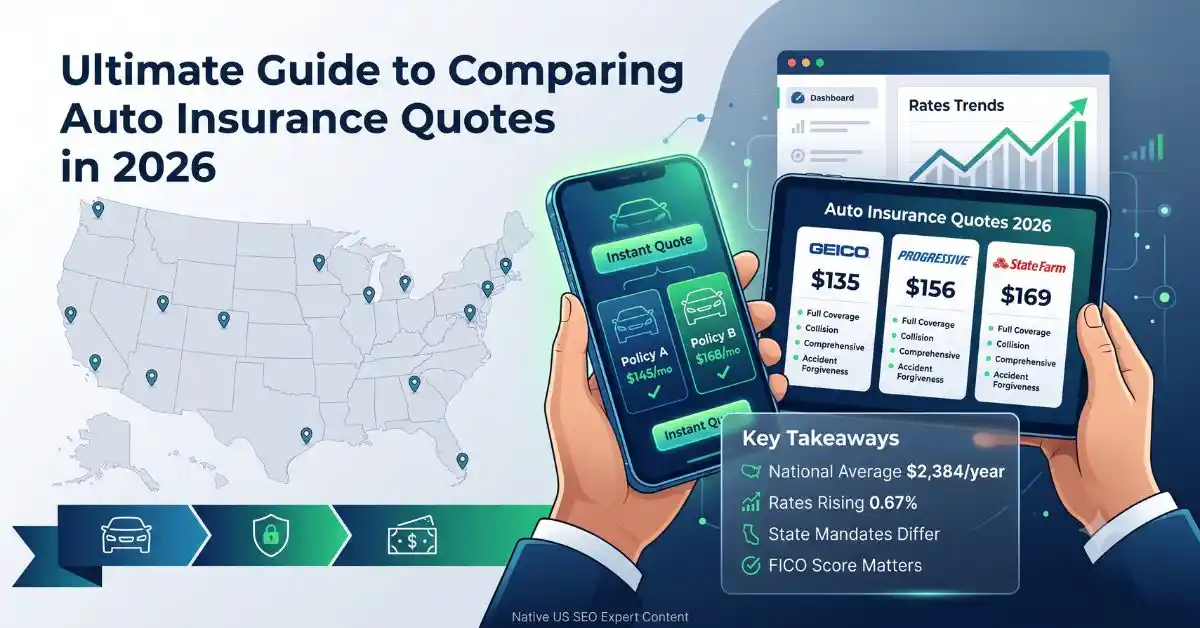
Getting accurate auto insurance quotes shouldn’t mean surrendering your inbox to endless spam. In 2026, comparing rates often feels like dodging lead-generation traps and bait-and-switch pricing. The US national average for full coverage sits at $2,384 annually. Still, your exact premium hinges on state mandates and your FICO score. We’ve cut the marketing fluff. Here is exactly how to lock in authentic, binding coverage today.
Quick Answer: You can bypass third-party lead generators completely. Apply directly through top carriers’ portals to secure an instant, accurate rate. You only need your Vehicle Identification Number (VIN) and current coverage declaration page.
💡 Key Takeaways
- National Averages (2026): Full coverage averages $2,384/year, while minimum liability sits at $780/year.
- Rate Trends: Following years of inflation, US premiums are projected to increase by a record-low 0.67% this year.
- Top Pricing Factors: Your credit-based insurance score, driving history, and state-specific DOI (Department of Insurance) mandates heavily dictate your final costs.
- Scam Warning: Never provide your Social Security Number (SSN) upfront to a website just to view an estimated monthly premium.
Costs, Pricing & Rates: Finding Cheap Auto Insurance Quotes Online
The cost of your policy comes down to the coverage tiers you select and how insurers calculate your specific risk. When searching for cheap auto insurance quotes online, understanding the price gap is crucial. You need to know the difference between a basic state-minimum policy and robust protection.
For 2026, the national average for a Minimum Liability policy hovers between $773 and $788 annually. This foundational tier satisfies state laws. It covers Bodily Injury (BI) and Property Damage (PD) liability for third parties if you cause a crash. Simply put, it provides zero payout for your own vehicle.
Liability vs. Comprehensive & Collision Coverage Costs
Upgrading to Full Coverage raises the national average to approximately $2,273 to $2,496 per year. This option integrates your standard liability with Collision Coverage and Comprehensive Coverage. The higher tier protects your personal financial assets. It pays for damages to your own car resulting from accidents, weather events, or theft, minus your chosen Deductible.
You can easily choose a higher Deductible, such as $1,000 instead of $500. Doing this will immediately lower your monthly Premium. Be careful here. If you finance or lease a vehicle, you are legally mandated by your lender to carry full coverage. Banks require this to protect their underlying asset.
How an Auto Insurance Online Quote Impacts Your FICO Score
A common consumer myth is that rate shopping will damage your credit history. That simply isn’t true. When you request an auto insurance online quote, the insurance carrier performs a “soft pull” on your credit report. This soft inquiry does not negatively affect your traditional FICO Score. The check remains completely invisible to future lenders.
Your existing financial standing still heavily dictates your pricing. The National Association of Insurance Commissioners (NAIC) reports that roughly 95% of auto insurers use a Credit-Based Insurance Score. They rely on this math to predict your likelihood of filing a future claim.
Because of this, US drivers with poor credit face an average annual premium of $4,644. That is roughly 88% more than individuals with excellent credit. A few states have stepped in to change these rules. Lawmakers in California, Hawaii, and Massachusetts strictly prohibit carriers from using credit scores to determine auto insurance rates.
Step-by-Step: Getting Accurate Auto Insurance Quotes Online
Getting a precise rate means matching your exact driver profile to a carrier’s underwriting algorithms. When you request auto insurance quotes online, accuracy comes down to the data you provide. Don’t guess your vehicle’s mileage. Don’t round up your coverage limits. If you do, expect a bait-and-switch premium once the insurer pulls your official motor vehicle record (MVR).
You need to lock in an enforceable rate. To do this, bypass third-party lead generators completely. Apply directly through the carrier’s encrypted portal. This strategy ensures you receive a legitimate, bindable policy. You won’t get stuck with an estimated “teaser” rate designed simply to harvest your data.
Documentation Checklist (VIN, License, Current Declaration Page)
Before generating an online quote for auto insurance, you need to prepare. Gather these three critical documents. They ensure the carrier’s underwriting tool can accurately assess your risk:
- Vehicle Identification Number (VIN): This 17-character code reveals your car’s exact trim, safety features, and anti-theft devices. These details often trigger automatic discounts.
- Driver’s License Numbers: You need the license numbers for every household member of driving age. Carriers will run a comprehensive Motor Vehicle Report (MVR) and CLUE (Comprehensive Loss Underwriting Exchange) Report.
- Current Declaration Page: This is also known as a “dec page.” It proves your continuous prior insurance history. It also lists your exact Coverage Limits and Deductibles. This ensures you are comparing apples-to-apples rates.
Comparison: Top Auto Insurance Companies Online Quotes Reviewed
Comparing rates across the largest carriers is the only proven method to combat localized inflation. Each underwriter weights risk differently. The cheapest carrier for a driver with excellent credit might be the most expensive for a driver with a recent speeding ticket.
When evaluating auto insurance companies online quotes, look beyond the initial premium. You must assess their digital claims processing, available discounts, and overall financial solvency.
Geico vs. Progressive vs. State Farm: 2026 Market Data
For 2026, the US market is dominated by State Farm and Progressive. They are battling for an 18.6% market share each. GEICO closely follows them. Here is how they stack up based on recent rate analyses:
| Carrier | Target Driver Profile | Average Monthly Rate (Full Coverage) | Standout Feature |
| GEICO | Drivers with Excellent Credit & Clean Records | $156 | Lowest rates for sedans and EVs. They offer an exceptional mobile app experience. |
| Progressive | High-Risk Drivers (DUI/Accidents) & Poor Credit | $172 | Features the Name Your Price Tool®. It heavily rewards drivers with poor credit compared to competitors. |
| State Farm | Drivers Seeking High Value & Local Agent Access | $169 | Holds the strongest claims satisfaction and customer service ratings among the “Big Three.” |
Data cited from 2026 national rate averages comparing the largest US carriers.
Pros & Cons of Getting an Online Quote for Auto Insurance
Opting for a digital-first approach offers immense convenience. Still, it comes with a few pitfalls. If you are a high-risk driver or have complex assets, like an umbrella policy, the digital route might leave gaps in your coverage.
Pros:
- Speed & Convenience: You can generate an insurance auto quote online in under 10 minutes. You can bind coverage instantly. This satisfies legal requirements for immediate vehicle purchases.
- No Sales Pressure: You avoid aggressive upselling tactics from commissioned agents. It allows you to manually adjust your Bodily Injury and Property Damage limits to see real-time price impacts.
- Direct Discounts: Many carriers offer an automatic “eSign” or “Paperless” discount when you secure your policy entirely online.
Cons:
- Lack of Personalized Advice: A digital algorithm will not explicitly warn you. It won’t tell you if your chosen Liability Limits are too low to protect your current net worth in the event of a severe lawsuit.
- Data Privacy Risks: Aggregator websites often sell your contact information to multiple agencies. This leads to relentless spam calls and emails.
- Missed Bundling Opportunities: Algorithms will easily suggest standard auto/home bundles. However, an experienced agent can often identify obscure Affinity Discounts. They also spot specialized commercial crossover savings that an automated system misses.
Frequently Asked Questions
- What is the cheapest car insurance company right now?
In 2026, Travelers and State Farm frequently offer the cheapest national rates. They average around $135 to $144 per month for full coverage. However, regional insurers or military-exclusive providers like USAA often yield even lower localized premiums for eligible drivers. - How much is full coverage auto insurance per month?
As of 2026, the US national average for full coverage auto insurance sits between $189 and $244 per month. Your final rate will still heavily fluctuate. It depends entirely on your Credit-Based Insurance Score, your motor vehicle record, and your exact ZIP code. - Can I buy car insurance online instantly without calling?
Yes. Most major carriers allow you to bypass agents completely. You can finalize a bindable policy entirely through their digital portal. You just need to provide a valid Vehicle Identification Number (VIN), your driver’s license, and the initial premium payment. After that, you can instantly download your digital proof of insurance. - Why did my car insurance go up in 2026?
Rates commonly increase due to localized spikes in vehicle repair costs or regional weather catastrophe payouts. A recent drop in your personal credit score can also hurt your premium. You might have a pristine driving record. Even so, carriers legally distribute the cost of regional risks across all active policyholders. - Does checking an auto insurance online quote affect my credit score?
No. Requesting a rate estimate only triggers a “soft inquiry” on your credit report rather than a hard pull. This specific type of background check is used strictly for actuarial risk assessment. It will never lower your traditional FICO Score.
Conclusion
Finding accurate pricing online requires a strategic approach. You need to protect both your wallet and your personal data. The bottom line is you must bypass third-party lead generators. Input your exact vehicle documentation directly into carrier portals. Doing this forces their underwriting algorithms to provide a legally bindable rate rather than a deceptive estimate. Ultimately, you should consistently compare auto insurance quotes every six to twelve months. This remains the single most effective strategy to outpace market inflation and secure the coverage your assets demand.
Disclaimer: The information provided in this article is for educational and informational purposes only. It does not constitute financial, legal, or insurance advice. Premium rates, coverage limits, and state regulations vary widely and are subject to change. Always consult with a licensed Property & Casualty (P&C) insurance agent or financial advisor before binding a policy or altering your coverage limits.








1 thought on “Auto Insurance Quotes: 2026 Guide to Compare Rates Instantly”