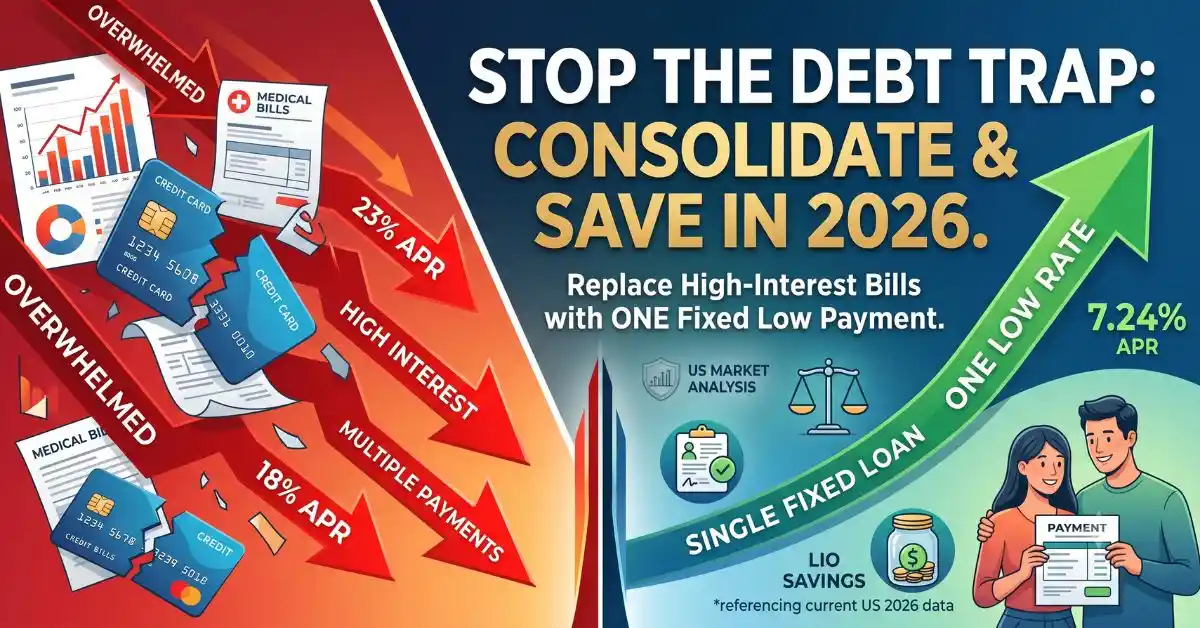
If you are struggling with high-interest credit card balances, debt consolidation could be your smartest financial move this year. Taking out a fixed-rate loan to pay off multiple revolving credit lines immediately stops the compounding interest trap. It is a smart strategy. However, securing the lowest APR depends heavily on your FICO score and your debt-to-income ratio (DTI). This guide explains 2026 lending standards. Let’s break this down so you can zero out your balances faster and save thousands.
💡 Key Takeaways: 2026 Market Snapshot
- Massive Rate Gap: The US average credit card APR sits at 22.15%. A personal loan for debt consolidation averages around 12.28%.
- Savings Potential: Swapping a $10,000 credit card balance for a 3-year consolidation loan could save an average US borrower over $1,800 in interest.
- Credit Impact: Consolidating multiple maxed-out credit cards into a single installment loan can rapidly improve your credit utilization ratio. This can potentially boost your FICO score.
- Approval Odds: Top US lenders currently demand a FICO score of 660+ and a DTI below 36% to qualify for their lowest advertised rates.
How to Qualify for a Personal Loan for Debt Consolidation
Getting approved for a personal loan for debt consolidation relies heavily on your credit profile. Lenders view you as a lower risk if you have a strong history of on-time payments and a stable income.
When you apply, banks perform a hard inquiry on your credit report. That action temporarily drops your score by a few points. However, the long-term benefit of lowering your credit utilization ratio usually offsets this initial dip.
Minimum FICO Score Requirements for Approval
You need a “Prime” or “Super Prime” FICO score to secure the lowest rates. As of mid-2026, most top-tier lenders require a minimum score of 660. Scores above 720 unlock the most competitive single-digit rates.
Borrowers with bad credit (below 600) face an uphill battle. Securing an unsecured personal loan becomes difficult. In these cases, adding a co-signer or applying for a secured loan backed by collateral may be your only viable path to approval.
How Your DTI Ratio Impacts Loan Terms
Your Debt-to-Income Ratio (DTI) measures how much of your gross monthly income goes toward debt payments. Simply put, this number matters. A lower DTI ratio signals to lenders that you have the cash flow to handle a new fixed monthly payment.
Most conventional US lenders look for a DTI below 36%. Some online fintech companies may accept up to 43%. If your DTI is too high, you might be denied even if your credit score is excellent.
Current APRs & Origination Costs for Debt Consolidation
Understanding the true cost of borrowing is crucial when comparing personal loans for debt consolidation. The Annual Percentage Rate (APR) includes both your interest rate and any upfront lender fees.
As of June 2026, the national average interest rate for a two-year personal loan at commercial banks is 11.86%. However, rates can range anywhere from 6.20% for excellent credit to 35.99% for subprime borrowers.
Watch out for the origination fee. It is a one-time charge lenders deduct from your total loan amount before depositing the funds. These fees typically range from 1% to 8%. On a $20,000 loan, you could lose up to $1,600 right out of the gate.
Comparing the Best Personal Loans for Debt Consolidation
Not every lender offers the same deal. Finding the best personal loan for debt consolidation means you need to shop around. Compare those APRs, term lengths, and sneaky hidden fees. Here is a quick snapshot of top-rated US lenders for 2026. We matched them up with specific credit profiles.
| Lender | Best For | 2026 Est. APR Range | Loan Amounts | Min. FICO |
| LightStream | Large Loan Amounts | 7.24% – 24.89% | $5,000 – $100,000 | 660+ |
| Discover | Good Credit Borrowers | 7.99% – 24.99% | $2,500 – $40,000 | 660 |
| Upgrade | Fair Credit & Fast Funding | 7.74% – 35.99% | $1,000 – $50,000 | 600 |
| Happy Money | Credit Card Consolidation | 7.95% – 35.99% | $5,000 – $50,000 | 620 |
(Note: These APRs include Autopay discounts when they apply. Check each lender’s website to see exact terms for your state.)
Pros & Cons of Using Personal Loans for Debt Consolidation
Paying off credit cards with a personal loan is a smart strategy. However, it will not magically fix underlying cash-flow problems. Let’s look at both sides.
| Pros (The Upside) | Cons (The Downside) |
| Lower Interest Rates: These rates often beat standard US credit card APRs by a wide margin. | Upfront Costs: Origination fees range from 1% to 8% and will cut into your actual loan payout. |
| Fixed Repayment Timeline: You get a firm payoff date, usually spanning 1 to 7 years. | Strict Approval Odds: You need a FICO score above 720 to lock in the most competitive rates. |
| Credit Score Boost: Moving revolving debt into an installment loan lowers your credit utilization. | Risk of “Double Debt”: Emptying your credit cards often tempts people to rack up new charges. |
Step-by-Step: How to Execute Your Consolidation Strategy
You need a clear plan of attack. Following the right steps prevents damage to your credit profile during the switch.
- Calculate Your Total Debt Load: Add up every single credit card balance. Write down your current APRs. Then, figure out your combined minimum monthly payments.
- Check Your Credit Profile: Grab your free credit report directly from AnnualCreditReport.com. Verify your FICO score. If you spot any reporting errors, fix them before you apply.
- Prequalify with Multiple Lenders: Shop around with lenders that offer a “soft credit pull.” This lets you check potential rates without dinging your score. Compare their APR offers to the weighted average rate of your current cards.
- Finalize the Application: Pick your lender and submit your paperwork. Expect to hand over W-2s and recent pay stubs. At this stage, the lender runs a hard inquiry to lock in your official rate.
- Disburse Funds Directly to Creditors: Many top lenders can pay your credit card issuers directly. This step ensures the money goes exactly where it should. Sometimes, this direct payment method even scores you a nice interest rate discount.
Frequently Asked Questions
Does a debt consolidation loan hurt your FICO score?
Applying for a loan will cause a minor dip in your score at first. This happens because of the hard credit inquiry. Do not panic. Your score typically rebounds quickly. It bounces back as your overall credit utilization ratio drops from paying off those maxed-out revolving balances.
What credit score do I need for a debt consolidation loan?
Most conventional US lenders and top online fintechs require a minimum FICO score of 660 for approval. You generally need a prime score of 720 or higher to secure the most competitive, single-digit interest rates.
Is it better to get a personal loan or balance transfer credit card?
A balance transfer card is a great choice if you can aggressively pay off the balance within the 0% introductory period. That window usually lasts 12 to 21 months. Some borrowers need three to five years to comfortably repay a larger debt load. A fixed-rate personal loan provides much more financial stability in those cases.
Can I get a personal loan for debt consolidation with bad credit?
Yes, you can. However, you will likely face steep APRs approaching the 35.99% legal cap. You should also expect hefty upfront origination fees. Adding a creditworthy co-signer is a smart move here. Opting for a secured loan backed by collateral is another strong option. Both of these strategies can drastically improve your approval odds and lower your rate.
How long does it take to get funds from a consolidation loan?
Many modern online lenders offer same-day or next-business-day funding. You just need your application and income verification to be fully approved first. Traditional brick-and-mortar banks and credit unions operate on a slower timeline. They typically take anywhere from three to five business days to disburse the funds.
Read this also : Auto Insurance Quotes: 2026 Guide to Compare Rates Instantly
Conclusion
Taking control of high-interest revolving balances is a critical step toward long-term financial health. The bottom line is that a strategic debt consolidation approach works. Securing favorable interest rates and committing to a strict, fixed repayment schedule can save you thousands of dollars. It can also rapidly improve your credit profile. You just have to play it smart. Remember to aggressively compare pre-qualified offers. Always read the fine print regarding origination fees. Most importantly, you must permanently adjust your daily spending habits to avoid falling into the “double debt” trap.
Disclaimer: The information provided in this article is strictly for educational and informational purposes only. It does not constitute financial, legal, or tax advice. You should always consult with a certified financial planner, fiduciary, or accredited credit counselor. Talk to a professional before making major financial decisions or entering into legally binding loan agreements.